

Introduction: Why Key Signatures Trip Up So Many Beginners
Have you ever looked at a piece of sheet music, seen a row of sharp or flat symbols right after the clef, and had no idea what key you were even playing in? You are not alone. This little cluster of symbols, called a key signature, tells you which notes to raise or lower for the whole song. But it does not spell out the key's name anywhere on the page.
Once you learn a couple of simple tricks, you will be able to do the following:
- Name the key of any piece just by glancing at the staff (the five horizontal lines music is written on)
- Memorize the order that sharps and flats always appear in
- Use the circle of fifths (a wheel-shaped chart that organizes all the keys) to find related keys fast
- Look up any major or minor key's signature without guessing
In this guide, we will break down exactly how key signatures work, give you two quick tricks for reading them, and include a full reference chart you can bookmark.

What Is a Key Signature, and Why Does It Matter?
A key signature is the group of sharp (#) or flat (b) symbols placed right after the clef at the start of a piece of music. A sharp raises a note by a half step (the smallest gap between two notes, like from a white key to the very next black key on a piano). A flat lowers a note by that same small step.
Instead of writing a sharp or flat next to every single note in the song, the key signature applies to every note of that letter name, in every octave, for the whole piece. For example, if the key signature has an F sharp, then every F you see is played as F sharp, unless a natural sign cancels it out later.
Knowing the key matters for more than just hitting the right notes. It helps you guess which chords will show up, predict how a melody might resolve, and read new music faster because you are not stopping to check every note. This is one of the basic building blocks of music theory (the set of rules that explain how music is put together).
The Order of Sharps and Flats: Learn This Once
Here is the good news: sharps and flats do not show up in a random order. They always follow the same pattern, and that pattern is the key to reading any key signature at a glance.
The order of sharps is always: F, C, G, D, A, E, B. A popular way to remember this is the sentence "Father Charles Goes Down And Ends Battle." Each word's first letter matches a sharp, in order.
The order of flats is the exact reverse: B, E, A, D, G, C, F. You can remember it with "Battle Ends And Down Goes Charles' Father." Notice it is the same sentence, just read backward, which makes both easy to recall together.
This matters because a key signature never skips ahead in this order. If a piece has three sharps, they will always be F#, C#, and G#, in that order, never some other combination. That consistency is what makes the next two tricks work.
The Fast Trick for Reading Sharp Key Signatures
Here is a shortcut that works for any key signature with one or more sharps: find the last sharp (the one furthest to the right), then go up one half step. That note name is your major key.
For example, imagine a key signature with three sharps: F#, C#, and G#. The last one is G#. Go up a half step from G#, and you land on A. That piece is in A major.
One key does not follow this rule, because it has zero sharps and zero flats: that is C major. It is worth memorizing as the simple starting point, since the trick only works once at least one sharp is present.
The Fast Trick for Reading Flat Key Signatures
Flat key signatures use a different, equally simple shortcut: the second-to-last flat in the signature is the name of the major key.
Take a key signature with four flats: Bb, Eb, Ab, and Db. Count back one from the last flat, Db, and you land on Ab. That piece is in Ab major.
This trick has one exception: a key signature with a single flat, which is F major. Since there is no second-to-last flat to point to, F major with one flat (Bb) is just worth memorizing on its own.
The Circle of Fifths: A Map for All the Keys
The circle of fifths is a wheel-shaped chart that arranges all twelve major keys (and their minor partners) in a circle, based on musical distance. Moving one step clockwise from C takes you up a fifth (an interval, or gap, spanning five notes) and adds one sharp. Moving counterclockwise adds one flat instead.
So starting at C major with zero sharps or flats, one step clockwise gives you G major with one sharp, then D major with two sharps, and so on. Going the other way from C gives you F major with one flat, then Bb major with two flats.
The circle is useful for more than memorizing signatures. Keys that sit next to each other on the circle share almost all the same notes, which is why songs often shift, or modulate (change key), to a neighboring key on the circle. It also explains why some keys, like F# major and Gb major, sound identical but are written differently. These are called enharmonic keys (two different names for the same sound).
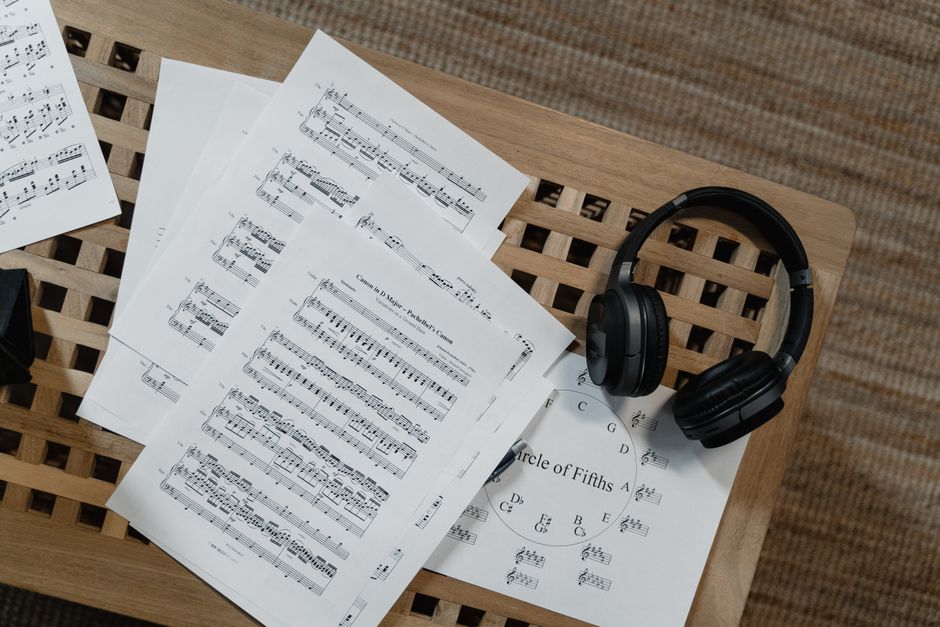
Reference Chart: Every Major Key and Its Relative Minor
Every major key has a relative minor, a minor key that shares the exact same key signature. You can find it by counting down three half steps from the major key's starting note, or by remembering the sixth note of the major scale. Here is the complete list, sorted by number of sharps or flats.
- 0 sharps/flats: C major, A minor
- 1 sharp (F#): G major, E minor
- 2 sharps (F#, C#): D major, B minor
- 3 sharps (F#, C#, G#): A major, F# minor
- 4 sharps (F#, C#, G#, D#): E major, C# minor
- 5 sharps (F#, C#, G#, D#, A#): B major, G# minor
- 6 sharps (F#, C#, G#, D#, A#, E#): F# major, D# minor (same sound as Gb major)
- 7 sharps (all seven letters): C# major, A# minor (same sound as Db major)
- 1 flat (Bb): F major, D minor
- 2 flats (Bb, Eb): Bb major, G minor
- 3 flats (Bb, Eb, Ab): Eb major, C minor
- 4 flats (Bb, Eb, Ab, Db): Ab major, F minor
- 5 flats (Bb, Eb, Ab, Db, Gb): Db major, Bb minor
- 6 flats (Bb, Eb, Ab, Db, Gb, Cb): Gb major, Eb minor (same sound as F# major)
- 7 flats (all seven letters): Cb major, Ab minor (same sound as B major)
Notice that the last sharp key and the last flat key on this list sound the same as keys near the top. Composers pick one spelling over the other based on which one is easier to read on the page for that particular piece.
Common Mistakes and Questions Beginners Run Into
A lot of beginners assume a key signature always means the major key, but it could just as easily be the relative minor. The only way to tell which one a piece is actually using is to look at the last chord or the note the melody keeps returning to and resting on.
Another common mix-up is forgetting that key signatures apply to every octave of that note, not just the one it looks closest to on the staff. If the key signature shows F#, every F in the piece is sharp, whether it is played by the left hand, the right hand, or a different instrument entirely.
People also sometimes try to memorize all fifteen key signatures by brute force. That works for a while, but it breaks down under pressure. The order-of-sharps and order-of-flats tricks above will get you the answer just as fast, and they never fail, because they are based on a pattern rather than raw memory.
A quick checklist to practice with real sheet music:
- Count the sharps or flats in the key signature
- If sharps: find the last one, go up a half step
- If flats: find the second-to-last one (or memorize F major for a single flat)
- Check the final note or chord to decide between the major key and its relative minor

Conclusion: Practice Makes This Automatic
Key signatures look intimidating at first, but they are really just a shorthand built on a pattern that never changes. Once the order of sharps and flats is locked into memory, the two tricks in this guide will let you name almost any key in a few seconds. Keep a copy of the reference chart nearby while you practice, and try naming the key on every new piece of sheet music you pick up. With a little repetition, reading key signatures will start to feel as natural as reading the notes themselves.
This article is for general information only and is not investment, financial, or purchasing advice. Prices, specs and availability change often, so check with the seller or manufacturer before you buy. Any decision and its outcome are your own responsibility.

Image credits
Post a Comment