

Introduction: Why Sheet Music Symbols Confuse So Many Beginners
"What does this symbol mean?" That question shows up constantly in beginner music forums, usually with a photo of a curved line or a strange mark hovering over a note. If you have ever stared at a page of sheet music and wondered what a squiggly line between two notes was supposed to tell you, you are not alone.
Sheet music uses a small set of symbols over and over again. Once you learn what each one means, you stop guessing and start reading with confidence.
- Tell the difference between a tie and a slur on sight
- Know exactly how long to hold a note marked with a fermata (a hold symbol shaped like a curved line with a dot under it)
- Understand repeat signs so you never skip or miss a section
- Recognize common accent marks that tell you to play a note louder or sharper
In this guide, we will break down each symbol in plain language, with a quick-reference list at the end you can bookmark and come back to.
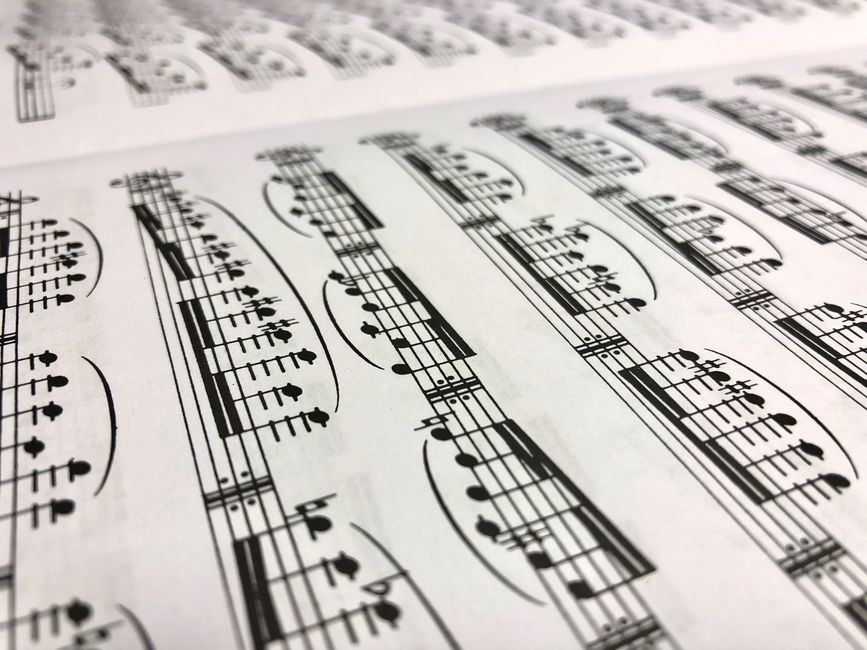
Tie vs Slur: The Two Curved Lines That Trip Up Every Beginner
Both a tie and a slur look like a curved line drawn above or below two or more notes. That is exactly why beginners mix them up. The difference comes down to one simple question: are the notes the same pitch or different pitches?
A tie connects two notes that sit on the exact same line or space, meaning they are the same pitch. A tie tells you to combine their duration into one longer sound and play the note only once. For example, a half note tied to a quarter note means you hold that single pitch for three beats total, not two separate hits.
A slur connects two or more notes of different pitches. It does not combine them into one sound. Instead, it tells you to play them smoothly and connected, without any gap or re-articulation between them. On a piano this means no separation between the notes; on a wind or string instrument it often means one breath or one bow stroke for the whole phrase.
Quick test: if the connected notes are on the same line or space (same pitch), it's a tie. If they're on different lines or spaces (different pitches), it's a slur.
There is one more thing that trips up beginners and looks similar at first glance: sometimes a note appears to be written twice, stacked right on top of itself, even though it is not connected by a curved line at all. This usually is not a tie or a slur. It means two separate musical lines, called voices, happen to land on the same pitch at the same moment. Think of a choir where two singers briefly sing the exact same note. You only hear one pitch, but the written music is showing you two parts moving independently. This shows up a lot in piano music by composers like Bach, Chopin, and Tchaikovsky, so do not panic if you run into it in a piece you are learning.

Fermata, Repeat Signs, and Accent Marks
Fermata: "Hold This Note Longer Than Written"
A fermata looks like a small curved line (like a half-circle) with a dot underneath it, sitting above or below a note or rest. It means hold that note, or pause on that rest, longer than its written value says.
A fermata does not come with an exact number of extra beats. The performer or conductor decides how long to hold it, based on the style of the music and what feels musically right. In sheet music, you will usually see a fermata at the end of a phrase or right before a big ending.
Repeat Signs: "Play This Section Again"
The most common repeat sign is a thick vertical line paired with two small dots, placed at the start and end of the section you need to repeat. When you reach the end repeat sign, you jump back to the matching start repeat sign and play that section one more time.
Two other repeat instructions show up often in longer pieces:
- D.C. (short for "da capo," which simply means "from the head" in Italian) tells you to go all the way back to the very beginning of the piece.
- D.S. (short for "dal segno," meaning "from the sign") tells you to jump back to a specific symbol marked earlier in the music, not necessarily the start.
A common beginner mistake is missing a repeat sign entirely and playing straight through, or forgetting to take a "second ending" the first time through a repeated section. Scan the whole page for repeat marks before you start playing.
Accent Marks: "Play This Note With a Bit of Punch"
An accent mark is a small arrow-like wedge (">") placed above or below a note. It tells you to play that single note louder or sharper than the notes around it, usually with extra emphasis right at the moment you strike or sound it.

Quick Reference: Bookmark This Symbol Cheat Sheet
- Tie — curved line, same pitch on both notes. Combine the duration and play it only once.
- Slur — curved line, different pitches. Play the notes smoothly connected, with no gap between them.
- Fermata — curved line with a dot. Hold the note or rest longer than written; the exact length is up to the performer.
- Repeat sign — thick line with two dots. Go back to the matching start sign and play that section again.
- D.C. / D.S. — text instructions. D.C. means jump back to the very beginning; D.S. means jump back to a marked sign.
- Accent (">") — small wedge above or below a note. Play that note louder or with more punch than the notes around it.
Conclusion: You Don't Need to Memorize Every Symbol at Once
Reading sheet music gets easier every time you look up a symbol and connect it to how it actually sounds. You do not need to memorize this entire list in one sitting.
Keep this page bookmarked, and the next time a curved line or odd mark stops you mid-practice, come back and check it. Over time, these symbols stop looking like a secret code and start reading like a second language you already know.
This article is for general information only and is not investment, financial, or purchasing advice. Prices, specs and availability change often, so check with the seller or manufacturer before you buy. Any decision and its outcome are your own responsibility.
Related posts
 How to Improve Your Sight-Reading Skills on Piano and Guitar악보 기호를 익힌 다음 바로 적용해볼 수 있는 시트 리딩(초견) 실전 가이드라서 자연스럽게 이어지는 글입니다.Read more →
 How to Train Your Ears for Music: A Beginner’s Guide to Ear Training초보자를 위한 음악 이론 입문 시리즈로, 기호 glossary를 읽은 독자가 다음 단계로 찾아볼 만한 귀 훈련 가이드입니다.Read more →
 5 Most Common Chord Progressions Every Beginner Should Know초보자가 함께 알아야 할 코드 진행 기초로, 표기법 글과 묶어 보면 악보 읽기-이해 흐름이 완성됩니다.Read more →
Post a Comment