

Introduction: Why This Odd Instrument Pairing Matters
Have you ever heard a piece of music where one sound never stops humming, while another sound dances freely around it? That is exactly what happens on Almost Starlight, an album by Jem Finer (a founding member of The Pogues) and John Matthias (a physicist and sound artist). They recorded it inside a small 11th-century church in Felpham, England, using just a violin and a hurdy-gurdy (an old crank-powered string instrument that makes a constant buzzing drone).
This pairing is not just a cool story. It is a real lesson in how composers build music out of unconventional instrument pairing and the room itself. Here is what you will get from this breakdown:
- A plain-language explanation of how a hurdy-gurdy actually makes its droning sound
- How violin phrasing (the way a melody rises, falls, and breathes) plays against that drone
- Why recording inside a stone church changes the music, not just the audio quality
- A few ways you can try this drone-and-melody idea yourself, even with cheap gear
In this post, we will break down the mechanics behind Almost Starlight step by step, so you can hear the album (or any drone-based music) with a sharper ear.

What Is a Hurdy-Gurdy, and Why Does It Drone?
A hurdy-gurdy looks a bit like a small guitar with a crank sticking out of the side. Instead of being plucked or bowed by hand, its strings are rubbed by a wooden wheel that spins when the player turns the crank. That wheel acts like a bow that never lifts off the strings, which is why the instrument can hold a note forever without the player ever running out of breath or arm strength.
Most hurdy-gurdies have at least two kinds of strings. Some strings are drone strings, tuned to one fixed note (or two notes a fifth apart) and left ringing the whole time. Other strings run under a row of keys, which the player presses to shorten the string and change the pitch, almost like a tiny keyboard glued onto a bowed instrument. Many hurdy-gurdies also have a loose bridge called the trompette, which buzzes rhythmically when the player cranks faster, adding a percussive pulse underneath the drone.
Put simply: a hurdy-gurdy gives you a held note, a simple melody line, and a rhythmic buzz, all from one box and one crank. That built-in drone is the foundation that the violin plays on top of throughout Almost Starlight.
How Violin Phrasing Works Against a Steady Drone
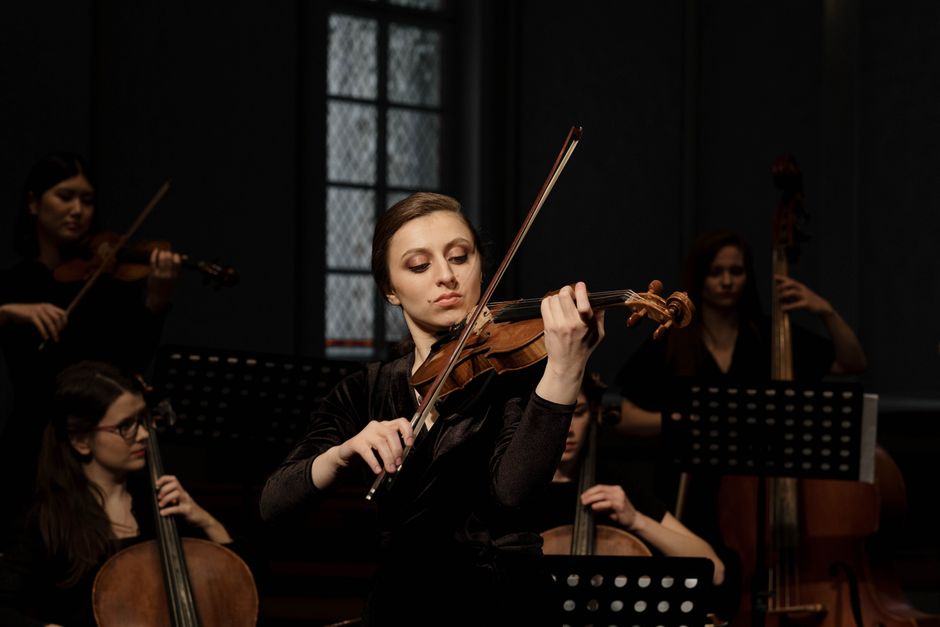
A violin works almost the opposite way. The player draws a bow across the strings and constantly changes pressure, speed, and finger position, which is what creates phrasing (the natural rise and fall of a musical line, similar to how a sentence has a beginning, a peak, and an ending). A violin melody can swoop, slow down, go quiet, or swell loudly, all things a steady hurdy-gurdy drone cannot do on its own.
This is where the chemistry between Finer and Matthias becomes interesting. In their interview, Matthias described recording a piece where he was not sure if he loved it or hated it, while Finer found it worked. That kind of creative tension is baked into the music itself: the hurdy-gurdy holds a fixed pitch while the violin pulls away from it and comes back, creating moments of calm and moments of friction.
Musicians sometimes call this effect tension and release. When the violin plays a note that clashes slightly with the drone, your ear feels a pull, almost like a small itch. When the violin resolves back to a note that matches the drone, that itch gets scratched. Repeating this pattern, over and over, is a large part of why drone-based music can feel hypnotic instead of boring, even though one instrument barely changes pitch.
Why Record Inside an 11th-Century Church?
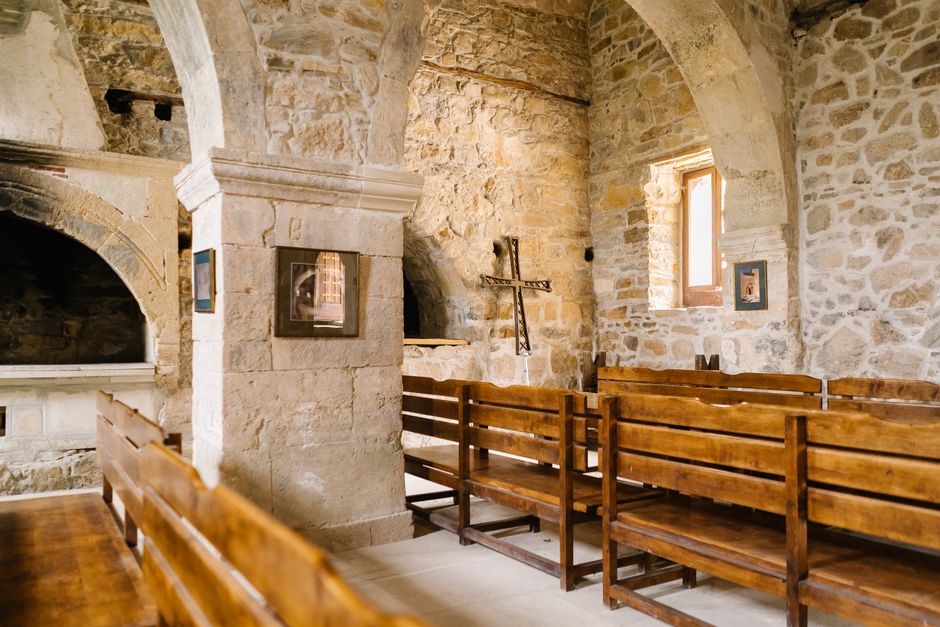
Finer and Matthias did not record Almost Starlight in a normal studio. They performed it live inside a stone church built roughly 1,000 years ago, in front of about 200 listeners. That choice was not just for atmosphere. Stone walls and high ceilings naturally hold sound in the air longer than a padded studio room does, through an effect called reverb (the trailing echo you hear after a sound happens, caused by it bouncing off hard surfaces).
For a droning instrument like the hurdy-gurdy, reverb is a gift. The church's echo stretches the drone out even further, so the held note seems to fill the whole room rather than just come from one small box in the corner. The violin's phrases get the same treatment, so even a short, quiet note can hang in the air a second or two longer than it would in a dry recording booth.
This is often called treating the room as an instrument. Instead of only choosing which notes to play, the composers also chose where to play them, because the space itself was shaping the sound just as much as their hands were. If you have ever noticed how singing in a tiled bathroom or an empty stairwell sounds fuller than singing in a carpeted bedroom, you already understand this effect on a small scale.
The Story Behind the Title Almost Starlight
The album's title came from an unusual source: What3Words, a system that labels every three-meter square of the world with three unique words. The church where they recorded happens to sit at the location tagged "Downhill.Almost.Starlight." Matthias and Finer liked how the phrase also fit their interest in deep time, since the atoms in our bodies originally came from inside stars, and starlight we see tonight may have left its source thousands or millions of years ago.
The album itself grew out of improvisation (playing without a fully written script, letting the music take shape in real time) between two friends who had known each other for about 20 years but had never built a full album from scratch together before. That long friendship matters for the sound: the two musicians already knew each other's instincts well enough to lean into disagreements, like the piece Matthias was unsure about, rather than smoothing them over.
What You Can Try at Home With Drone and Melody
You do not need a hurdy-gurdy or a medieval church to experiment with this idea. Here are a few accessible ways to test it yourself:
- Use a free drone app, a cheap harmonium, or even a bagpipe drone recording as your steady base note.
- Play or sing a melody on top using a guitar, violin, or your voice, and notice which notes feel calm against the drone and which ones feel tense.
- Record yourself in a tiled bathroom, stairwell, or empty garage instead of a quiet bedroom, and compare how much longer the notes seem to linger.
- Try holding one note far longer than feels natural, then slowly bend away from it and back, to hear tension and release in your own playing.
These are the exact same building blocks Finer and Matthias used, just scaled down to whatever instruments and rooms you already have access to.
Conclusion: Why This Odd Pairing Works
A droning hurdy-gurdy and a phrasing violin seem like an unlikely match on paper, but that is exactly why Almost Starlight works so well. The drone gives listeners something steady to hold onto, the violin gives them something that moves and breathes, and the old stone church ties both together with natural echo. Try listening to the album again with these mechanics in mind, or better yet, try building your own version of tension and release with whatever drone and melody instruments you have nearby.
This article is for general information only and is not investment, financial, or purchasing advice. Prices, specs and availability change often, so check with the seller or manufacturer before you buy. Any decision and its outcome are your own responsibility.
Related posts
Minyo Crusaders' NYC Debut: What Is Japanese Min'yo Folk Music?민요 크루세이더스 글도 전통/민속 악기가 어떻게 실험적 사운드로 재해석되는지 다뤄, 허디거디·바이올린 드론 이야기와 자연스럽게 이어집니다.Read more → Suntou Susso and the Griot Tradition: What Her Kora Music Really Means코라와 그리오 전통처럼 비서구권 민속 악기가 담는 음악적 의미를 다룬 글이라, 허디거디의 드론 메커니즘 이야기를 읽은 독자가 이어서 궁금해할 만합니다.Read more →
How to Train Your Ears for Music: A Beginner’s Guide to Ear Training드론과 교회 공명이 만드는 미묘한 음향 효과를 이해하려면 결국 귀 훈련이 필요하기 때문에, 이론 글을 통해 더 깊이 들어갈 수 있습니다.Read more →
Suntou Susso and the Griot Tradition: What Her Kora Music Really Means코라와 그리오 전통처럼 비서구권 민속 악기가 담는 음악적 의미를 다룬 글이라, 허디거디의 드론 메커니즘 이야기를 읽은 독자가 이어서 궁금해할 만합니다.Read more →
How to Train Your Ears for Music: A Beginner’s Guide to Ear Training드론과 교회 공명이 만드는 미묘한 음향 효과를 이해하려면 결국 귀 훈련이 필요하기 때문에, 이론 글을 통해 더 깊이 들어갈 수 있습니다.Read more →Image credits
Post a Comment